
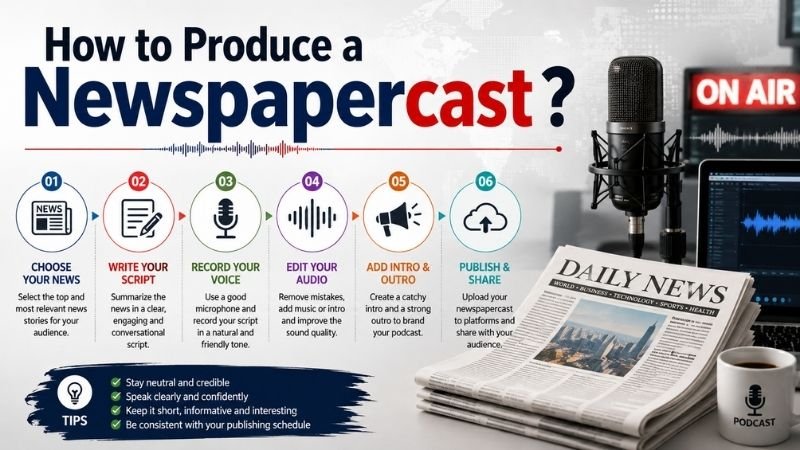
Newspapercast is the evolution of print journalism into broadcast-style formats like audio and video. It strives to deliver accurate reporting in formats easily accessible by audiences worldwide.
Select an experienced communicator as the anchor for your newscast. They should feel at home on camera and possess an engaging persona; furthermore, they must be well organized and willing to put in the work necessary for producing an excellent broadcast.
Scripting the newscast
Writing the newscast script is a key step in producing any radio or television news show. For optimal results, the newscast should feature engaging language that’s easy on the ears while remaining concise enough to conform with broadcast rules – typically, this means staying away from controversial topics and sticking to news headlines.
Newspapercast is the natural progression of traditional newspaper journalism in today’s digital era, offering the power to stay current, reach new audiences and uphold editorial integrity all at the same time. Newspapercast serves as an essential asset when navigating today’s media landscape.
Organizing the news segments
Organization of news segments is one of the primary tasks of a broadcaster, typically carried out by a producer and consisting of organizing stories in chronological order. However, this task can prove challenging since new events may arise between assignments and newscasts (for instance a local government story may shift up or down according to viewer importance). Television shows tend to group their news by genre while newspapers segregate news by its construction.
How people consume news has evolved rapidly over the past several years, as people transition between print and digital media consumption. Traditional newspapers still enjoy strong followings; however, with news aggregators and paid subscription services challenging their business models. Newspapercast is an evolution of newspaper reporting for an on-the-go audience; adapting trusted journalism into audio/video formats which increase audience engagement while simultaneously reinforcing trust. By providing verified news in multiple formats it reinforces brand recognition while simultaneously optimizing existing reporting and decreasing production costs while increasing audience engagement – in short it keeps newspapers relevant by meeting readers’ concerns directly.
Putting the news segments together
Producing news segments together is known as “stacking the show.” A producer plays an essential role in this aspect of newscast production; their task requires them to ensure all stories are arranged according to importance and fit well with one another; furthermore, segments must be timed accordingly; an ideal newscast should last about 22 minutes to accommodate advertising opportunities.
Assembling a newscast requires selecting strong communicators who are comfortable on camera and who can write news in an approachable, conversational tone that can be read aloud – this will create a connection with viewers while earning trust of their target audience. A newscast should feature weather, sports, human interest stories as well as any additional relevant stories that didn’t make the main block.
Social media and the internet have revolutionized how people access news. While traditional newspapers still exist, more consumers now prefer accessing news online compared to in print form, leading to advertising revenue decline significantly for newspapers. To remain relevant in a rapidly-changing media landscape, newspapers must adapt to consumer habits by finding ways to reach them via digital channels.
One way of doing this is newspapercast, a digital transformation technology that converts newspaper content to audio and video for broadcast. Newspapercast enables publishers to remain relevant in an ever-evolving media landscape while upholding editorial standards while satisfying modern audiences while building credibility and brand recognition.
Newspapercast differs from podcasts by basing it on existing reporting and adhering to strict editorial guidelines, making it easy for newspapers to remain relevant in a rapidly-evolved media landscape, while simultaneously showing that verified journalism can thrive through different formats.
Putting the newscast together
Establishing a newscast may seem daunting at first, but with proper planning and tools in place it’s possible for anyone to create professional-looking broadcasts. With today’s wide array of tools to choose from, creating newscasts shouldn’t be daunting or stressful!
At first, gather all the most current news stories. Once compiled, decide on their order and how much time each story needs to run for maximum engagement with audiences. Some stations start local news broadcasts before moving onto state and national headlines before concluding with international newscasts; this helps engage viewers from start to finish and keeps them attentive throughout. Some broadcast journalists also look for an “upbeat story” at the end of their newscast to keep viewers smiling about life!
Next, draft out a script for your newscast. This should include an introduction and outro segment as well as an outline of major stories you will cover. Be sure to fact check your sources and maintain consistency throughout the show. Additionally, choose an anchor – some stations use announcers while others opt for reporters who gather information through interviews and information gathering.
Once you’ve written your newscast script, read it aloud several times to make sure it reads smoothly and flows naturally. This will allow you to identify any flaws in the storyline, as well as getting an idea of how long each segment should last. Also review your copy to check for editing needs such as word emphases or pronunciation of difficult words if needed. Finally, remember to keep track of how much time each segment is taking so as not to exceed your allotted running time!




One thought on “How to Produce a Newspapercast ?”